
Mescaline Peyote — Botanical Profile, Cultural Heritage, Chemistry & Scientific Research Overview
Mescaline Peyote refers to the naturally occurring psychoactive alkaloid mescaline (3,4,5-trimethoxyphenethylamine) as found in Lophophora williamsii — a small, spineless cactus indigenous to the Chihuahuan Desert of northern Mexico and southern Texas, commonly known as peyote. For thousands of years, peyote has occupied a central place in the spiritual and medicinal traditions of Indigenous peoples of Mesoamerica and the American Southwest, making it one of the longest continuously used psychoactive plants in human history.
Mescaline is classified as a phenethylamine-class psychedelic and is the primary psychoactive constituent responsible for the visionary, perceptual, and cognitive effects associated with peyote ceremonial use. It was first isolated in pure form by German pharmacologist Arthur Heffter in 1897 and subsequently synthesized by Ernst Spath in 1919, making it one of the first psychedelic compounds to be studied systematically by Western science.
From a regulatory standpoint, mescaline is listed as a Schedule I controlled substance under the U.S. Controlled Substances Act, as well as under Schedule I of the United Nations Convention on Psychotropic Substances (1971). However, the peyote cactus itself — and its ceremonial use by members of the Native American Church (NAC) — is explicitly exempted from federal prosecution in the United States under 21 U.S.C. § 1307.31, recognizing the profound religious and cultural significance of this sacramental plant. This document is an educational and scientific overview intended for researchers, ethnobotanists, historians, and academic audiences.
Botanical & Chemical Profile Overview
| Common Name | Peyote, Mescal Button, Divine Cactus, Hikuri (Huichol) |
| Scientific Name | Lophophora williamsii |
| Plant Family | Cactaceae |
| Primary Alkaloid | Mescaline (3,4,5-trimethoxyphenethylamine) |
| Chemical Class | Phenethylamine; Psychedelic |
| CAS Number (Mescaline) | 54-04-6 |
| Molecular Formula | C11H17NO3 |
| Molecular Weight | 211.26 g/mol |
| Mescaline Content | Approximately 0.4% fresh weight; 3–6% dry weight of alkaloids |
| Other Alkaloids | Hordenine, tyramine, pellotine, anhalonidine, lophophorine (30+ total) |
| Native Range | Chihuahuan Desert: northern Mexico (Tamaulipas to San Luis Potosí) and southern Texas |
| Traditional Use | Sacramental and medicinal — Huichol, Tarahumara, and Native American Church traditions |
| DEA Schedule (Mescaline) | Schedule I Controlled Substance (USA) |
| Legal Exemption (USA) | Bona fide religious use by Native American Church members (21 U.S.C. § 1307.31) |
| UN Convention Status | Schedule I — Convention on Psychotropic Substances (1971) |
Botanical Description of Lophophora williamsii (Peyote Cactus)
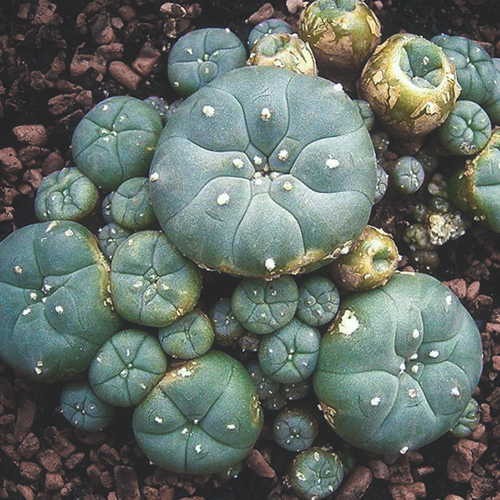
Lophophora williamsii is a remarkably slow-growing, small, spineless cactus that rarely exceeds 5–12 cm in diameter and 2–7 cm in height above ground. Its unassuming appearance belies its profound cultural and pharmacological significance. The plant features a soft, blue-green to grey-green rounded body divided into ribs bearing areoles tufted with soft white or yellowish wool-like trichomes in place of the spines characteristic of most cactus species.
The plant grows predominantly as a geophyte — with the majority of its body, including a large carrot-shaped taproot (often many times larger than the visible crown), buried beneath the soil surface. This growth pattern provides protection from herbivory and temperature extremes in its harsh desert habitat. The visible crown, called the “button” or “mescal button,” is the portion traditionally harvested and used in ceremonial contexts.
Growth, Reproduction & Conservation Status
Peyote exhibits an exceptionally slow growth rate, with plants typically requiring 10–30 years to reach reproductive maturity from seed. A single plant produces delicate pink or white flowers from its central areole, followed by small pink seed pods. Due to decades of overharvesting, habitat destruction from land conversion, and limitations imposed by drug control laws that restrict legal cultivation, wild peyote populations in Texas and Mexico have declined significantly.
Conservation organizations and Indigenous communities have raised serious concerns about peyote’s long-term availability for traditional ceremonial use. In Texas, where wild peyote grows in a limited region known as the “Peyote Gardens,” a small number of licensed peyote distributors legally supply harvested buttons exclusively to members of the Native American Church. The species is listed as vulnerable in some regional assessments, and conservation-minded cultivation and sustainable harvesting practices are actively advocated by ethnobotanists and Indigenous rights organizations.
Ethnobotanical History & Indigenous Cultural Significance
The documented history of peyote use by Indigenous peoples of Mesoamerica extends back at least 5,700 years, with archaeological evidence of peyote buttons found in the Shumla Cave burial sites of Texas dating to approximately 3780–3660 BCE. More recent radiocarbon dating of peyote specimens from the Río Grande region suggests continuous ritual use spanning millennia, making peyote one of the most ancient sacramental substances known to anthropology.
Huichol (Wixáritari) Tradition
Among the Huichol (Wixáritari) people of the Sierra Madre Occidental in Mexico, peyote — known as hikuri — is considered the most sacred of all plants and forms the foundation of their spiritual cosmology. The annual peyote pilgrimage (Hikuri Neixa) to the sacred desert of Wirikuta in San Luis Potosí, where the Huichol believe the world was created, has been practiced without interruption for centuries. During the pilgrimage, community members harvest peyote under the guidance of traditional healers (mara’akames), who use the plant in elaborate multi-day ceremonies involving prayer, song, fasting, and visionary communion with ancestral deities.
For the Huichol, peyote is not merely a plant but a living deity — Kauyumari, the sacred deer spirit — whose consumption enables direct communication with the spirit world, healing of physical and spiritual ailments, guidance from ancestors, and renewal of the community’s relationship with the natural and divine order. This theological framework positions peyote use as a deeply solemn and structured sacramental act, not recreational consumption.
Tarahumara (Rarámuri) and Other Indigenous Traditions
The Tarahumara (Rarámuri) of Chihuahua use peyote ceremonially and medicinally, employing it in healing rituals, endurance running preparation, and religious festivals. Numerous other Indigenous groups across northern Mexico — including the Tepehuán, Cora, Kickapoo, and Tonkawa — have incorporated peyote into their spiritual and healing practices, each with distinct cultural protocols governing its preparation, use, and significance.
Native American Church and Legal Protections in the United States
The Native American Church (NAC), formally organized in Oklahoma in 1918 and now representing an estimated 250,000–300,000 members across the United States and Canada, synthesizes traditional Indigenous peyote religion with elements of Christianity. Peyote ceremonies (“meetings”) typically last through the night, involving prayer, singing, water drumming, meditation, and consumption of peyote buttons as the central sacrament, guided by a Road Chief (ceremony leader).
Following decades of legal persecution and conflicting court rulings, the American Indian Religious Freedom Act Amendments of 1994 explicitly protect the traditional use, possession, and transportation of peyote by Native American Church members for bona fide religious ceremonies. This federal exemption applies regardless of state law in most circumstances, though individuals must be of documented Native American heritage to qualify for the exemption under most state implementations.
Chemistry of Mescaline & Peyote Alkaloids
The psychoactive properties of peyote are attributable to its complex alkaloid profile, which includes over 50 identified alkaloids. Mescaline accounts for approximately 30–60% of total alkaloid content and is the principal psychoactive compound. The remaining alkaloids — including phenethylamines (hordenine, tyramine) and tetrahydroisoquinolines (pellotine, anhalonidine, anhalonine, lophophorine) — contribute to the plant’s overall pharmacological character and may modulate the mescaline experience.
Mescaline: Structure and Chemical Properties
Mescaline (3,4,5-trimethoxyphenethylamine) is a small phenethylamine molecule with three methoxy groups attached to the aromatic ring at the 3, 4, and 5 positions. This structural arrangement is responsible for its selective affinity for serotonin receptors, distinguishing it pharmacologically from the catecholamine neurotransmitters (dopamine, norepinephrine) that share the phenethylamine backbone but lack the methoxy substitution pattern.
- Molecular formula: C11H17NO3
- Molecular weight: 211.26 g/mol
- Melting point: 35–36°C (free base); 181°C (hydrochloride salt)
- Appearance: Colorless to white crystalline solid (hydrochloride salt form)
- Solubility: Freely soluble in water (as HCl salt); sparingly soluble in alcohol
- Structural class: Phenethylamine; structurally related to dopamine, norepinephrine, and the 2C family of psychedelics
Biosynthesis of Mescaline in Lophophora williamsii
Mescaline is biosynthesized in peyote through a well-characterized biochemical pathway beginning with the amino acid tyrosine. Tyrosine is hydroxylated and decarboxylated to form dopamine, which is then methylated in a stepwise fashion by O-methyltransferase enzymes to produce 3-methoxytyramine, followed by further methylation and oxidative steps leading to the final 3,4,5-trimethoxyphenethylamine structure. This biosynthetic route is shared, in part, with the synthesis of other plant phenethylamines and illustrates the evolutionary relationship between plant secondary metabolites and animal neurotransmitter systems.
Pharmacology & Mechanism of Action of Mescaline
Mescaline’s psychedelic effects are primarily mediated through agonist activity at serotonin receptors in the brain, particularly the 5-HT2A receptor subtype — the same primary receptor target shared by other classical psychedelics including LSD (lysergic acid diethylamide) and psilocybin. This shared mechanism of action places mescaline within the serotonergic psychedelic class, distinct from dissociatives (ketamine, PCP) and empathogens (MDMA).
Primary Receptor Mechanism: 5-HT2A Agonism
5-HT2A receptors are densely expressed in the prefrontal cortex, visual cortex, and limbic system — brain regions involved in perception, cognition, emotion, and consciousness. Mescaline’s agonism at 5-HT2A receptors disrupts normal thalamo-cortical filtering of sensory information, producing the characteristic alterations in visual perception, thought processes, emotional tone, and self-referential cognition that define the psychedelic state. Neuroimaging studies suggest that 5-HT2A activation by psychedelics increases cortical entropy and disrupts the default mode network — a resting-state brain network associated with self-referential thought and the sense of personal identity.
Additional Receptor Interactions
- 5-HT2C receptor agonism: Contributes to altered mood, appetite suppression, and anxiogenic effects
- 5-HT1A receptor partial agonism: May moderate the intensity of the psychedelic experience
- Dopamine receptor activity: Weak interactions with dopaminergic systems may contribute to stimulant-like effects at the onset of the mescaline experience
- Trace amine-associated receptor 1 (TAAR1): Phenethylamine structure suggests potential TAAR1 activity, though this remains an area of ongoing investigation
Pharmacokinetics
Mescaline is well absorbed orally, with peak plasma concentrations achieved approximately 1–2 hours after ingestion. The compound crosses the blood-brain barrier readily. Its half-life is approximately 6 hours in humans, with a total duration of psychoactive effects typically lasting 8–12 hours. Mescaline undergoes limited hepatic metabolism — primarily via monoamine oxidase (MAO) and deamination pathways — and is excreted largely unchanged in the urine. Unlike LSD and psilocybin, mescaline does not undergo significant first-pass metabolism, contributing to its relatively high oral bioavailability.
Documented Experiential & Perceptual Effects
The phenomenology of mescaline and peyote experiences has been documented extensively in ethnographic, clinical, and self-report literature. The following descriptions are drawn from historical clinical research, anthropological accounts, and controlled psychedelic research contexts. These effects are presented for scientific and educational understanding only.
Onset, Duration & Phases
- Onset: 45–90 minutes following oral ingestion of peyote or mescaline
Peak effects: 3–6 hours post-ingestion
- Duration: Full experience typically lasts 8–12 hours; residual effects may persist for several additional hours
- Come-up phase: Often characterized by nausea, autonomic arousal, and initial perceptual changes
- Peak phase: Maximum perceptual, cognitive, and emotional alterations
- Resolution phase: Gradual return to baseline with persistent reflective or integrative quality
Perceptual and Cognitive Effects Reported in Research Literature
- Visual phenomena: Intensified color perception, geometric visual patterns (open and closed eye), object boundary dissolution, and synesthesia (cross-modal sensory fusion)
- Altered time perception: Time may appear greatly slowed or accelerated
- Enhanced sensory sensitivity: Amplified perception of sound, texture, and movement
- Ego dissolution: At higher doses, dissolution of the ordinary sense of self-other boundaries, reported as central to traditional ceremonial experiences
- Emotional amplification: Intensification of pre-existing emotional states; potential for profound awe, empathy, or, conversely, anxiety
- Cognitive novelty: Unusual associative thinking, increased pattern recognition, and altered perspective on personal or philosophical questions
- Mystical-type experiences: In structured ceremonial or therapeutic settings, mescaline reliably occasions experiences rated as among the most meaningful of one’s life in controlled research
Scientific Research Context & Therapeutic Potential
Interest in mescaline as a subject of scientific inquiry began in the late 19th century, intensified through the mid-20th century during the first wave of psychedelic research, waned following Schedule I classification in the 1970s, and has re-emerged in the contemporary renaissance of psychedelic medicine research.
Historical Research (1890s–1970s)
Following its isolation in 1897, mescaline attracted significant scientific attention as a tool for investigating the neurological basis of hallucination, psychosis, and altered states of consciousness. German psychiatrist Kurt Beringer published landmark research on mescaline phenomenology in 1927. The compound influenced the work of Aldous Huxley, whose 1954 essay “The Doors of Perception” brought mescaline to mainstream cultural awareness and sparked broader intellectual discussion about consciousness, perception, and the mind-body relationship. Early clinical researchers explored mescaline’s potential for treating alcoholism, anxiety disorders, and as an adjunct to psychotherapy.
Contemporary and Emerging Research Areas
The current resurgence of clinical psychedelic research — driven in part by promising results with psilocybin and MDMA — has renewed scientific interest in mescaline and peyote. Areas of active or emerging investigation include:
- Treatment-resistant depression: Mescaline shares mechanistic similarities with psilocybin, which has demonstrated significant efficacy in Phase II clinical trials for treatment-resistant depression; preliminary studies and anecdotal reports suggest comparable antidepressant potential
- Post-traumatic stress disorder (PTSD): Survey data from Native American Church members and non-Indigenous mescaline users suggests potential therapeutic benefits for trauma processing
- Addiction and substance use disorders: Historical and contemporary survey research suggests associations between peyote use in NAC ceremonial contexts and reduced rates of alcohol and substance misuse among Indigenous communities
- Neuroscience of consciousness: Mescaline’s distinctive phenomenological profile — including its prolonged duration and complex alkaloid context — makes it a valuable comparator compound in consciousness research alongside LSD and psilocybin
- Microdosing research: Sub-perceptual doses of mescaline are being investigated in observational and survey studies for effects on mood, creativity, and cognitive flexibility
Legal Status & Regulatory Framework
The legal status of mescaline and peyote is complex and varies significantly across jurisdictions, reflecting the tension between drug control policy, Indigenous religious rights, and the evolving scientific understanding of psychedelic substances.
United States Federal Law
Mescaline is classified as a Schedule I controlled substance under the Controlled Substances Act of 1970, meaning it is deemed to have no currently accepted medical use and a high potential for abuse under federal law. However, the peyote cactus and its ceremonial use by members of the Native American Church are explicitly exempted from this prohibition under 21 C.F.R. § 1307.31, as reinforced by the American Indian Religious Freedom Act Amendments of 1994. This exemption does not extend to non-Native Americans, to non-ceremonial use, or to synthetic mescaline.
International Regulatory Status
- United Nations: Mescaline is listed in Schedule I of the 1971 Convention on Psychotropic Substances, obligating signatory nations to restrict its manufacture, distribution, and possession
- Mexico: Possession and use of peyote by Indigenous communities for traditional ceremonial purposes has historically been tolerated and is culturally protected, though mescaline remains a controlled substance
- Netherlands: Mescaline is listed as a Schedule I substance (Opium Act), though fresh peyote cacti exist in a legal gray area
- Canada: Mescaline is a Schedule III controlled substance; peyote plants are not scheduled and may be possessed
- United Kingdom: Mescaline is a Class A controlled substance under the Misuse of Drugs Act 1971
- Germany: Mescaline is listed in Anlage I (non-prescribable narcotics)
- Australia: Schedule 9 prohibited substance under the Standard for Uniform Scheduling of Medicines and Poisons
Frequently Asked Questions About Mescaline Peyote
What Is the Difference Between Mescaline and Peyote?
Peyote refers to the Lophophora williamsii cactus plant in its natural botanical form, while mescaline is the specific phenethylamine alkaloid — one of over 50 alkaloids present in the plant — that is primarily responsible for peyote’s psychoactive effects. Mescaline can also be found in other cacti species, most notably San Pedro (Echinopsis pachanoi) and Peruvian Torch (Echinopsis peruviana), as well as in several other plant families. Synthetic mescaline can be chemically produced and is identical to the naturally occurring compound. The subjective experience of whole peyote is commonly described as qualitatively distinct from isolated synthetic mescaline, likely due to the entourage effects of the plant’s complex alkaloid matrix interacting with the primary mescaline constituent.
How Does Mescaline Compare to Other Psychedelics?
Mescaline shares its primary mechanism of 5-HT2A receptor agonism with psilocybin (from magic mushrooms) and LSD, placing all three in the classical serotonergic psychedelic category. Key distinguishing features of mescaline include its significantly longer duration of action (8–12 hours versus 4–6 hours for psilocybin), its phenethylamine chemical structure (versus the tryptamine structure of psilocybin and LSD), its relatively higher effective dose (200–400mg+ compared to micrograms of LSD), and the distinctly embodied, sensory-rich quality of the mescaline experience that many researchers and ethnographers describe as unique within the psychedelic class. Cross-tolerance exists between mescaline, LSD, and psilocybin through their shared 5-HT2A mechanism.
Is Peyote Endangered?
While not officially listed as endangered on the IUCN Red List at the global level, peyote (Lophophora williamsii) populations have undergone significant decline — estimated at over 30–50% reduction in parts of its range — due to a combination of overharvesting, habitat loss from land conversion to agriculture and ranching, urbanization in its native range, and legal barriers that discourage cultivation. In Texas, wild peyote grows only in a limited 4-county region and is under increasing pressure. Ethnobotanists and Indigenous advocacy groups have called for conservation programs, cultivation legalization to reduce pressure on wild populations, and sustainable harvesting protocols to protect this culturally and ecologically significant species for future generations.
| Quantity | 25 Grams, 50 Grams, 100 Grams, 250 Grams, 500 Grams, 1 Kg |
|---|
Be the first to review “Buy Mescaline Peyote Online”
Related products
Psychoactive Herb
Psychoactive Herb

Psychoactive Herb
Psychoactive Herb
Psychoactive Herb
Psychoactive Herb
Psychoactive Herb


Reviews
There are no reviews yet.